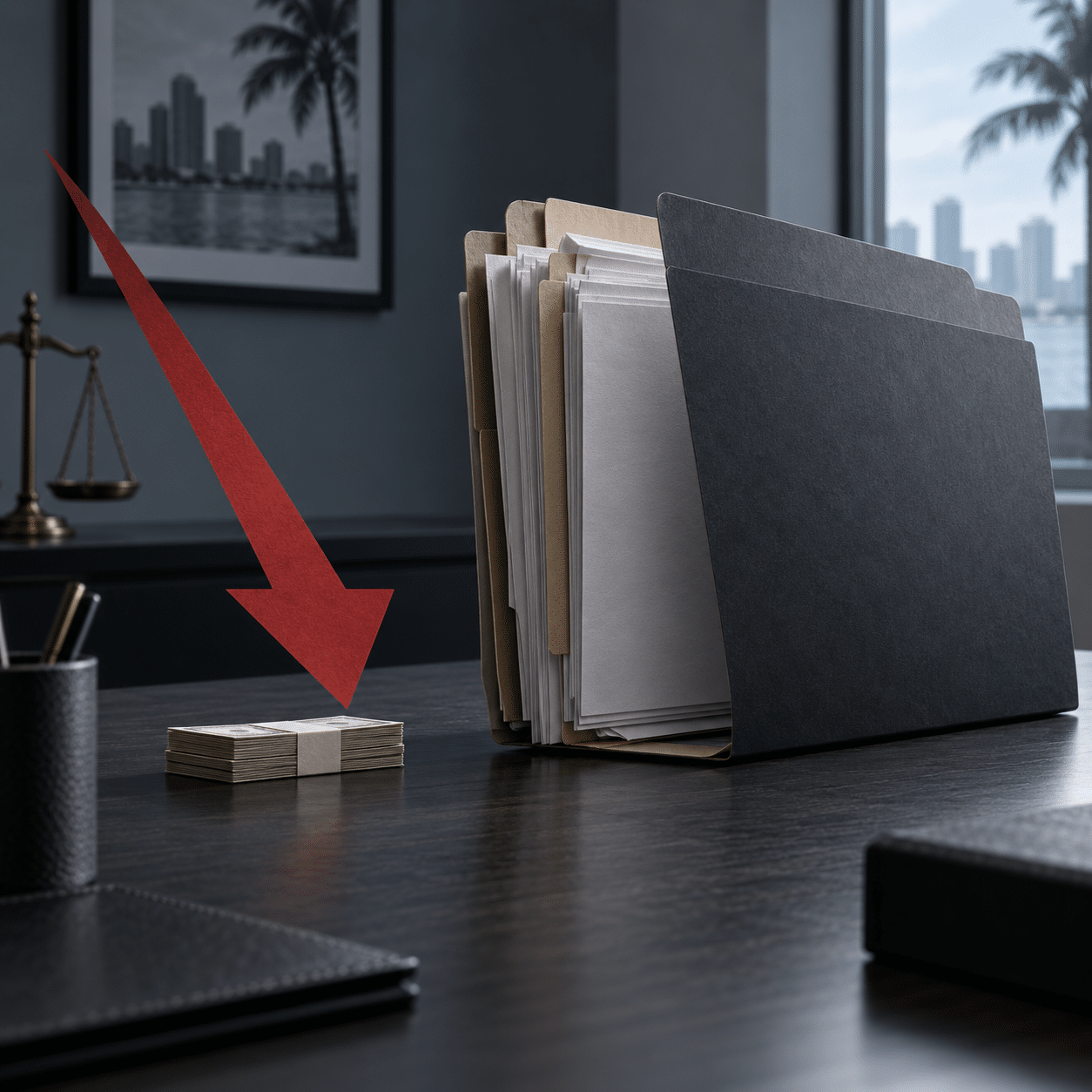
The offer is not an assessment of your injury. It is an assessment of your file, and the difference is where the money lives.
An adjuster with two claims involving identical herniations at C5 and C6 will value them wildly differently based on things that have nothing to do with your spine: whether liability is contested, whether you gave a recorded statement, whether you have a treatment gap, and, above all, how much coverage exists.
The ceiling nobody mentions in the first phone call
Florida requires ordinary drivers to carry $10,000 in personal injury protection and $10,000 in property damage liability. It does not require bodily injury liability coverage at all. If the at fault driver bought only what Florida makes him buy, the number available to compensate you for a surgical injury is zero, no matter what your damages are.
This is why an experienced attorney’s first day of work is rarely spent on your medical records. It is spent looking for coverage: the at fault driver’s policy, the vehicle owner’s policy if the car was borrowed, an employer’s policy if the driver was working, a resident relative’s policy, and your own uninsured motorist coverage under section 627.727.
“This is our best and final offer, and it is generous given the circumstances.”
Translation: we have valued the risk of you doing anything about it as low.
An offer is a prediction of what happens if the insurer does not pay: the cost of defense, the odds of a verdict, its size, and the likelihood you go away. Every one of those inputs changes when the file changes.
The fast policy limits tender, and why it is not a gift
Occasionally the opposite happens. The injury is catastrophic, liability is obvious, and the carrier tenders its full policy limits within weeks, sometimes before you have asked. That speed is not generosity. It is section 624.155.
Florida’s bad faith statute gives an insurer a safe harbor: a bad faith action does not lie if the insurer tenders the lesser of the policy limits or the amount demanded within ninety days after receiving actual notice of the claim with sufficient evidence to support it. Miss that window and the limitations period extends by another ninety days, and the insurer’s exposure can exceed its policy limits.
The underlying duty is older. Florida law has long required a liability insurer to handle claims with the care a reasonably prudent person would use managing his own business, including a duty to advise the insured of settlement opportunities and, in the right circumstances, to initiate negotiations rather than wait to be asked.
What the 2023 reforms did to that fight
The 2023 reforms amended section 624.155 twice in ways that matter to you. First, mere negligence alone is now insufficient to constitute bad faith. Sloppy claims handling is no longer automatically actionable.
Second, the claimant has obligations too. The statute now contemplates that a claimant and his representative act in good faith in furnishing information, making demands, setting deadlines and attempting to settle, and a fact finder may consider a failure to do so. Manufactured deadlines and gotcha demand packages now carry a cost.
How to read any offer in thirty seconds
What are the available policy limits, from every possible source. What are the total medical specials and documented wage losses. What has the insurer actually disputed in writing, as opposed to implied on the phone.
If the offer is at or near the limits and the limits are all there is, that offer may genuinely be the ceiling, and the remaining work is on your own uninsured motorist coverage and your liens. If the offer is a fraction of the limits, you are not being told the value of your claim. You are being told the value of your file as it sits.
Files can be changed. That is the entire job. If you have an offer in hand from a crash in Spring Hill, Brooksville or anywhere in Hernando County, have a car accident attorney tell you which situation you are in before you sign the release.
External legal resource: Florida Statutes, section 768.81 (Comparative Fault)
—
Injured in a Collision? Make the Right Decision.
A car crash can leave you overwhelmed, injured, and unsure what to do next. But you do not have to figure it out alone.
If you were hurt in a Florida car accident, contact Brijbag Law for a free consultation.
Brijbag Law
In a Collision? Make the Right Decision.
Call: (352) 358-5880
No pressure. No upfront cost. Just answers.