
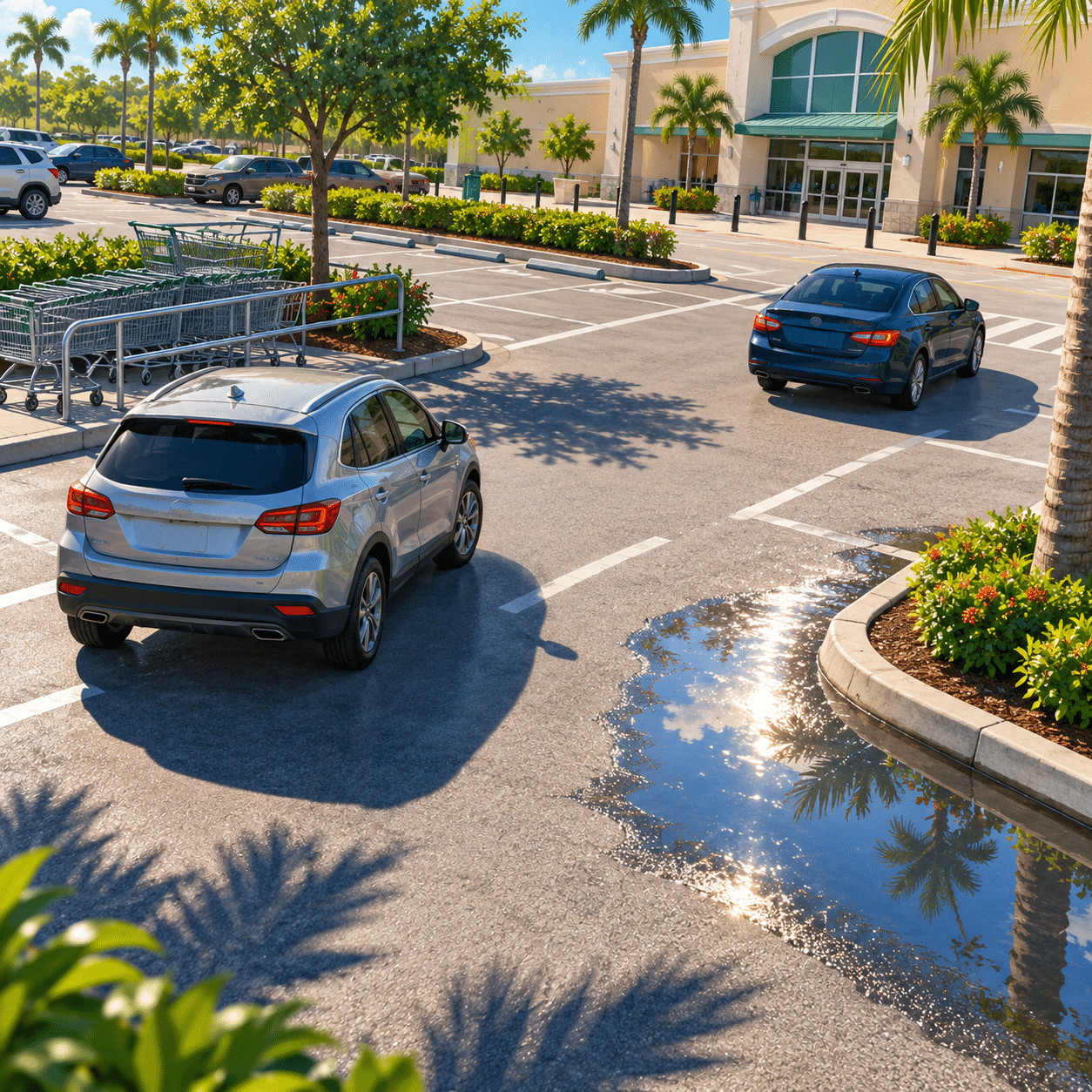
A remarkable number of Floridians believe that a parking lot is a lawless commons where fault does not attach, insurance does not apply, and everyone simply exchanges hostile eye contact and drives home. This belief is held with real conviction, usually by the person who backed out.
It is wrong in every direction, and the parking lot at your local Publix produces three legally distinct kinds of injury case. They are worth telling apart, because they have almost nothing in common.
One: the low speed collision
Two cars, five miles an hour, one crumpled quarter panel. Ordinary negligence rules apply. The driver backing out of a space generally owes a duty to yield to vehicles already traveling in the lane, and the driver in the lane owes a duty to keep a proper lookout and travel at a reasonable speed for conditions, which in a crowded lot on a Sunday is slower than you were going.
The complication is evidence. Law enforcement frequently will not prepare a crash report for a minor collision on private property. That means no diagram, no witness list, no independent narrative.
So build the record yourself. Photograph both vehicles in their final resting positions before anyone moves, along with the space, the lane, the sight lines and the plate. Get a phone number from anyone who saw it. Ask the store immediately to preserve the camera footage, because retention periods are often measured in days.
And do not let anyone tell you a low speed crash cannot injure you. Whether a herniation is credible is a medical question, not a bumper question.
Two: the fall
Different case, different statute, much harder.
Section 768.0755 governs slip and fall injuries caused by a transitory foreign substance in a business establishment. The injured person must prove the business had actual or constructive knowledge of the dangerous condition and should have remedied it.
Constructive knowledge can be proven circumstantially by showing either that the condition existed for such a length of time that the business should have discovered it in the exercise of ordinary care, or that the condition occurred with regularity and was therefore foreseeable.
Read that second option again, because it is the one people forget. A single unlucky puddle is a hard case. A drainage pattern that floods the same corner of the lot in every afternoon storm, in a county that has an afternoon storm most of the summer, is a different case entirely. Regularity is provable through prior incident reports, work orders, maintenance records and employee testimony.
Report the fall to a manager before you leave, in writing, and get a copy or at least the incident number. Photograph the substance, the lighting and the drain while it is still there.
Three: the car you lent to your nephew
Florida treats a motor vehicle as a dangerous instrumentality. That doctrine, which traces to Southern Cotton Oil Co. v. Anderson in 1920, makes the owner of a vehicle vicariously liable for the negligence of a person to whom he voluntarily entrusts it. You do not have to be in the car. You do not have to be in the county.
There are limits. Section 324.021(9)(b) caps the vicarious exposure of an owner who lends a vehicle, generally at $100,000 per person and $300,000 per incident for bodily injury and $50,000 for property damage, with additional economic damages exposure when the driver is underinsured. The federal Graves Amendment largely shields commercial rental companies. None of those caps protect an owner against his own independent negligence, such as entrusting a car to someone he knew should not be driving.
So when the keys go across the kitchen counter, some of the liability goes with them and some stays with you.
If you were hurt in a parking lot in Spring Hill or Brooksville, do not let anyone tell you it does not count. Fourteen days for PIP, two years under section 95.11(5)(a), and a Hernando County personal injury attorney worth calling this week rather than next year.
External legal resource: Florida Statutes, section 768.0755 (Premises Liability for Transitory Foreign Substances)
—
Injured in a Collision? Make the Right Decision.
A car crash can leave you overwhelmed, injured, and unsure what to do next. But you do not have to figure it out alone.
If you were hurt in a Florida car accident, contact Brijbag Law for a free consultation.
Brijbag Law
In a Collision? Make the Right Decision.
Call: (352) 358-5880
No pressure. No upfront cost. Just answers.