
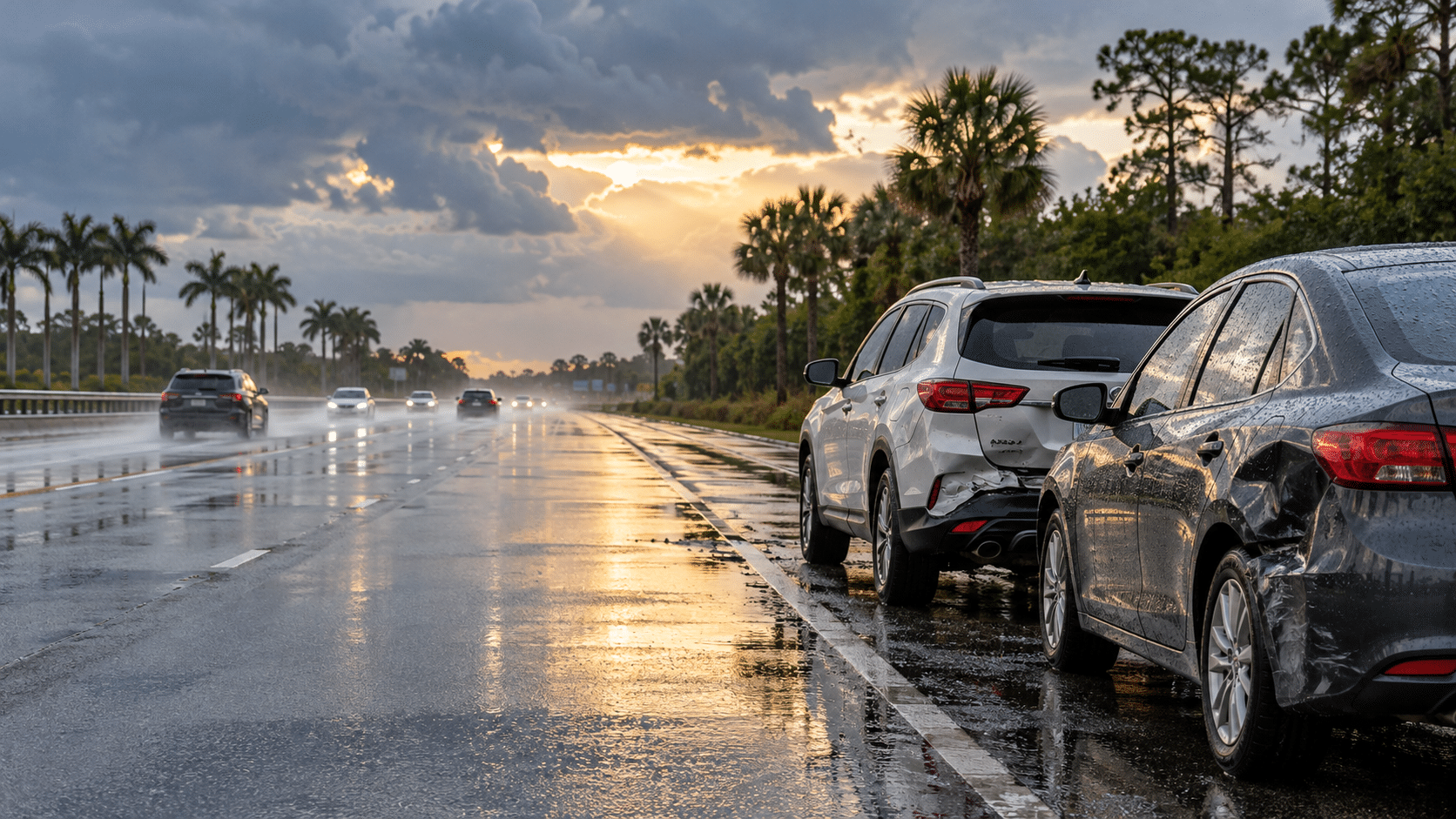
A driver loses control on a wet road, hits your car, and says there was nothing they could do. Does the rain mean nobody is responsible?
No. Rain does not automatically excuse a driver from responsibility for a Florida car accident. The question is whether the driver used reasonable care for the conditions and whether a failure to do so caused your injuries.
For people driving on Commercial Way, Spring Hill Drive, or Cortez Boulevard, that distinction matters. An insurance adjuster may point to the weather. Your claim should also examine the speed, following distance, visibility, and decisions that led to the collision.
Florida Drivers Must Adjust Their Speed for Rain
The posted speed limit is only part of the picture. Under Florida Statutes section 316.183, drivers must travel at a speed that is reasonable for existing conditions. The statute specifically requires an appropriately reduced speed when weather or highway conditions create a special hazard.
That means a driver can be traveling below the posted limit and still be going too fast for heavy rain or poor visibility. For example, driving 40 mph in a 45 mph zone may be unsafe when the driver cannot see stopped traffic soon enough to avoid a collision.
A weather related crash still requires an investigation. Wet pavement alone does not establish negligence, and a collision does not automatically prove that someone drove carelessly.
Does Hydroplaning Mean a Driver Is Not at Fault
Hydroplaning describes how a vehicle lost traction. It does not, by itself, answer whether the driver is legally responsible.
An investigation may consider whether the driver slowed down before entering standing water, left enough space to stop, or made an unsafe lane change. Tire condition and vehicle maintenance may also matter. The evidence must connect any careless conduct to the crash and resulting harm.
Suppose a driver follows closely behind your vehicle during a downpour and slides into you when traffic stops. The rain is relevant, but so are the following distance and the opportunity to slow down. Compare that with an unusual hazard that a reasonably careful driver could not have anticipated. Those situations call for different conclusions.
What to Do After a Rain Related Car Accident in Spring Hill
- Put safety first. Call 911 for injuries or an immediate danger. Follow emergency responders’ instructions, and do not stand in an active traffic lane to take pictures.
- Get medical care promptly. Tell the provider what happened and describe your symptoms accurately. Do not wait for an insurance company to decide who caused the crash before seeking needed treatment.
- Document the conditions if it is safe. Photograph the vehicles, road surface, standing water, lane markings, and sight lines. Keep the original files.
- Collect identifying information. Obtain the other driver’s insurance and contact information, witness details, and the investigating agency’s crash report number.
- Preserve recordings and expenses. Save dashcam footage before it is overwritten. Keep medical bills, repair estimates, receipts, and records of missed work.
- Report the crash to your insurer promptly. Follow your policy’s notice and cooperation requirements. Understand any release or settlement before signing it.
Evidence That Can Matter When the Other Driver Blames the Weather
A photograph taken after the clouds clear may tell an incomplete story. Evidence from the time of the collision can help establish what a driver could see and how traffic was moving.
Useful material may include dashcam video, nearby business surveillance, witness accounts, photographs of water on the road, and weather records for the location and time. Vehicle damage and available electronic data may help reconstruct the collision. Where tire condition is disputed, inspection before repair or disposal may be important.
Ask an attorney about preserving evidence early. A nearby camera may overwrite footage long before an insurance claim is resolved. A crash report can help identify witnesses and basic facts, but a claim should be evaluated using all available evidence.
How Florida PIP Benefits Apply After a Wet Weather Crash
For an eligible person with applicable coverage, personal injury protection, or PIP, provides certain benefits regardless of who caused the crash. Under Florida Statutes section 627.736, qualifying initial medical services and care must occur within 14 days after the accident to qualify for PIP medical benefits.
PIP generally pays 80 percent of reasonable, medically necessary covered expenses and 60 percent of covered lost income, subject to deductibles, eligibility rules, and policy limits. The statutory medical and disability benefit limit is generally $10,000 combined. Access to the full medical benefit amount depends on a qualifying emergency medical condition determination; a $2,500 medical limit can apply without one.
The 14 day rule concerns PIP medical benefits. It is not the deadline to file a negligence lawsuit, and missing it does not automatically eliminate every other potential claim.
Can You Recover Compensation If You Were Partly at Fault
For a current crash governed by Florida’s comparative fault statute, your share of responsibility generally reduces your damages. If you are found more than 50 percent responsible for your own harm, you generally cannot recover damages in the negligence action.
For a simplified example, if your damages are $100,000 and you are 20 percent at fault, the reduction leaves $80,000 before other applicable adjustments. Being exactly 50 percent at fault does not trigger the greater than 50 percent bar.
This makes the evidence especially important when both drivers say the other failed to adjust to the rain.
What Compensation May Be Available
Depending on the facts, available insurance, and proof, a claim may include medical expenses, lost income, reduced earning capacity, and vehicle damage. These losses must be supported by evidence, and overlapping payments require careful accounting.
Pain and suffering damages require separate analysis. In motor vehicle cases subject to Florida Statutes section 627.737, recovery for those noneconomic losses generally requires a qualifying injury, such as a permanent injury within a reasonable degree of medical probability, significant and permanent loss of an important bodily function, significant and permanent scarring or disfigurement, or death. That threshold should not be confused with whether every unpaid economic loss is recoverable.
How Long Do You Have to File a Florida Car Accident Lawsuit
For a recent Florida crash, a lawsuit based on negligence generally must be filed within two years under Florida Statutes section 95.11. The accident date, type of claim, and any applicable exceptions must be reviewed to calculate the actual deadline.
Do not assume that an open insurance claim or ongoing settlement discussions extend the time to sue. Evidence preservation and insurance obligations may require action much sooner.
Questions About Rain Related Car Accident Claims
Can I Bring a Claim If the Other Driver Was Below the Speed Limit
Potentially. A lawful posted speed does not resolve whether the speed was reasonable for the weather. You still need evidence of negligence, causation, and damages.
Does No Fault Insurance Mean Nobody Is Responsible
No. No fault describes how certain insurance benefits are paid. Responsibility still matters when pursuing a negligence claim against another driver.
Do I Have to Wait for the Insurance Company Before Calling a Lawyer
No. You can seek legal advice while the claim is being investigated, especially if fault is disputed, your injuries require ongoing care, or important video may be lost.
Talk With a Spring Hill Car Accident Attorney
If you were injured in a rain related crash in Spring Hill, Brooksville, Weeki Wachee, or elsewhere in Florida, Brijbag Law can review the circumstances, available coverage, and next steps. Our car accident attorneys can help evaluate a claim when weather is part of the dispute.
Call (352) 358-5880 or contact Brijbag Law for a free consultation. We have offices in Hernando and Citrus counties and serve clients throughout Florida.
This article provides general information, not legal advice for a particular case. Reading it or contacting the firm does not create an attorney-client relationship.