As of October 1, 2026, Florida changed one little number in its traffic code, and almost nobody noticed. That number decides whether you have to call the police after a crash. It used to be $500. Now it’s $2,000.
Let’s be honest about $500 in 2026. That buys you a side mirror, a headlight bulb, and a strongly worded apology in the Publix parking lot. The Legislature decided it was time to catch up, so it passed SB 488 and bumped the reporting threshold in Florida Statute 316.065 to $2,000.
Sounds like a win for everyone who hates waiting on the shoulder of US-19 for 90 minutes. It might be. But if you get hurt, that shiny new number can quietly wreck your claim.
What Actually Changed
Under the new law, a driver must immediately notify law enforcement if a crash causes injury, death, or damage to a vehicle or property in an apparent amount of at least $2,000. Nobody hurt and damage that looks like less than $2,000? You aren’t required to call.
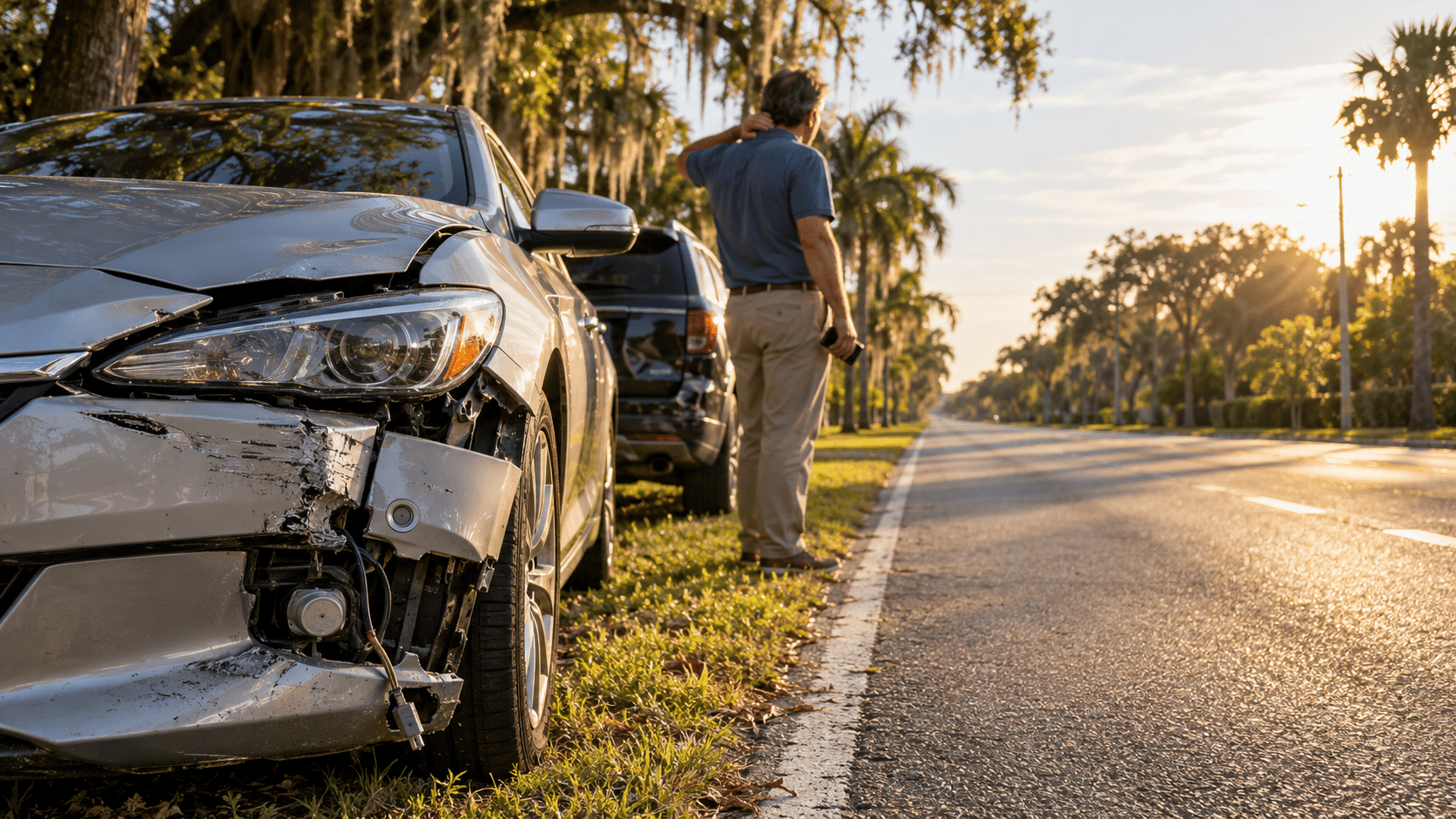
Notice that word “apparent.” It’s doing a lot of heavy lifting. Today’s bumpers aren’t bumpers. They’re rolling electronics cabinets full of parking sensors, radar units, cameras, and foam that exists solely to crumple expensively. The scuff that looked like $800 in the Walmart lot on Commercial Way becomes a $3,600 estimate once the body shop pulls the cover off. Nobody standing on the roadside is a certified estimator. Least of all the other driver.
What Did NOT Change
Here’s what the new law leaves exactly where it was:
- Injuries still mean a call. Any injury, and under Florida Statute 316.066 even a “complaint of pain or discomfort,” calls for a full long-form police report. Your neck doesn’t care what the damage estimate says.
- You still have to exchange information. Name, address, registration, and insurance. Driving off without doing that is still leaving the scene.
- No police report means YOU file one. If no law enforcement report is required, Florida law says each driver must submit a written crash report to the state within 10 days. “No cop” does not mean “no paperwork.”
Why This Matters for Your Injury Claim
A police report isn’t the whole case, but insurance companies love one. It’s a neutral, dated record of who was where, who said what, and who got the ticket. Take it away and your crash becomes a he-said, she-said story, and the insurance adjuster is very happy to referee.
That matters more in Florida than almost anywhere. Under our modified comparative negligence law, if you’re found more than 50% at fault, you recover nothing. Without an officer’s report, the other driver’s version of events suddenly has a lot more room to grow.
Then there’s the injury problem. Whiplash and back injuries often don’t announce themselves until the next morning. By then, the crash that “didn’t need a cop” has no official record at all. And Florida’s PIP law requires you to get initial medical treatment within 14 days, or you can lose access to those benefits.
Your Sub-$2,000 Survival Guide
- When in doubt, call. Nothing in the law punishes you for reporting a $1,500 crash. Dial 911 for injuries, or *FHP (*347) from a cell phone.
- Photograph everything. Both vehicles, the scene, the other driver’s license, insurance card, and license plate.
- Get witness names and numbers. Strangers vanish fast.
- Don’t say “I’m fine.” Say “I’ll get checked out.” Then actually do it, well before day 14.
- File your self-report within 10 days if no officer wrote one.
- Watch the clock. Most Florida negligence claims now carry a two-year statute of limitations.
Hurt in a “Minor” Crash? Talk to a Lawyer Before the Insurance Company Does
There’s no such thing as a minor crash when you’re the one who can’t turn your head. If you were injured in a car accident in Spring Hill, Brooksville, or anywhere in Hernando County, the car accident attorneys at Brijbag Law can help you build the record the police never made. Call us today for a free consultation.
This article is for general informational purposes only and is not legal advice. Reading it does not create an attorney-client relationship. Every case is different; consult a lawyer about your specific situation.